 Eau Claire Crawlspace
Eau Claire Crawl Space Repair
Moisture damage, rot, and sagging floors fixed at the cause by licensed, insured local contractors.
Crawl space repair means fixing what standing water and humid air have already done to your house: rotted or sagging floor joists, ruined insulation, torn vapor barriers, and the mold that grows on all of it. A licensed, insured local contractor handles the job in that order, stopping the moisture first, then repairing the structural damage it caused, so the same problem doesn't come back in a year. If you're not sure yet whether it's damage or just a smell, a crawl space inspection sorts that out first.
What causes crawl space damage in Eau Claire?
Most damage traces back to two seasons: spring snowmelt soaking into ground that's still frozen or saturated (March to May), and humid summer air condensing on cool crawl space surfaces (June to August). Slow-draining clay and silt soils common across west-central Wisconsin hold that water against the foundation instead of letting it run off.
The median Eau Claire home was built in 1974, and nearly one in five city homes predates 1940. Houses that age were mostly built with vented crawl spaces, which were standard practice at the time but let outside humidity straight in during the summer condensation season. Over years, that cycle of wet, dry, wet again is what breaks down wood framing, insulation, and vapor barriers. The full mechanism, including why vented crawl spaces struggle here specifically, is covered on our local climate guide.
What are the signs my crawl space needs repair?
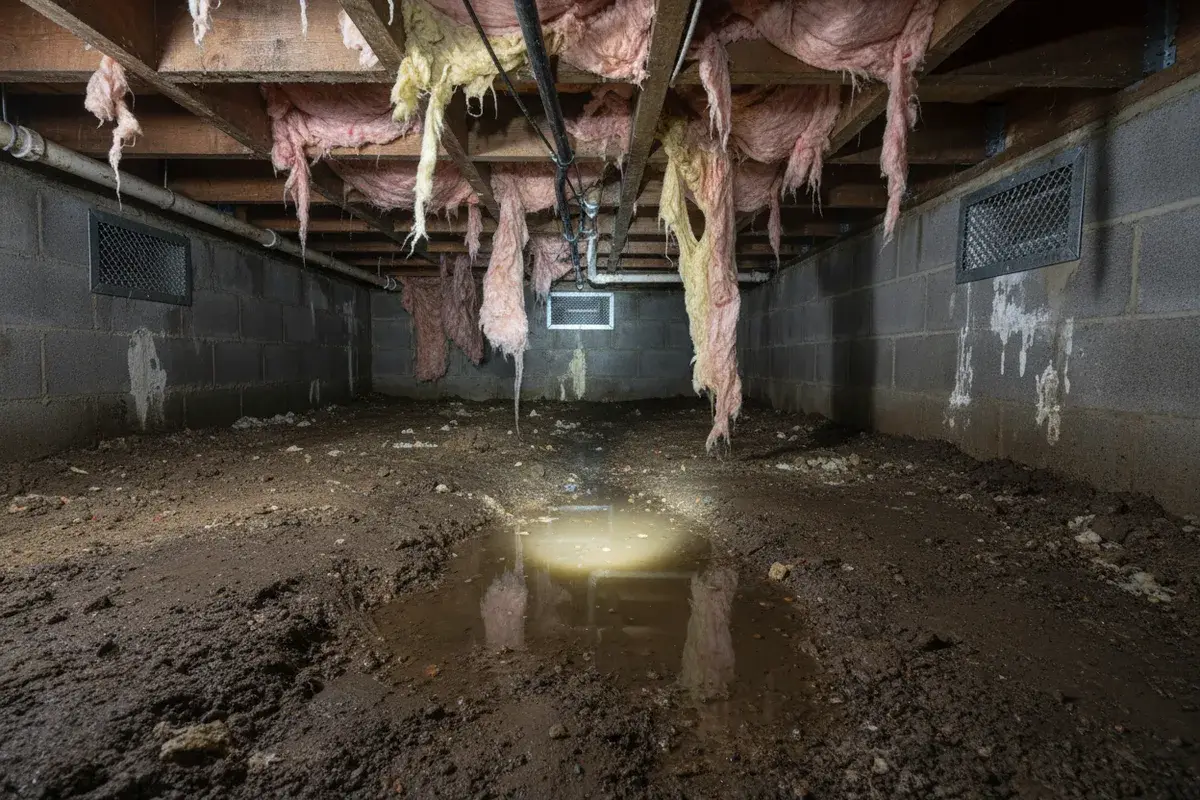
A musty smell that gets stronger in summer, floors that feel cold or bounce underfoot, insulation hanging down or stained dark, visible mold on joists, and standing water or damp soil after snowmelt are the common signs. Any one of them is worth a look before the damage spreads further.
Musty, earthy smell, worse in warm weather
Sagging or bouncy floors above the crawl space
Insulation that's fallen, wet, or discolored
Visible mold or dark staining on wood framing
Standing water or wet gravel every spring
A torn, loose, or missing vapor barrier
What does crawl space repair actually involve?
Repair starts with stopping the moisture: sealing a torn vapor barrier, closing gaps that let in water, or adding drainage. Only after that does the structural work happen: sistering or replacing rotted joists, pulling out ruined insulation and installing new, and clearing out debris. Doing the structural fix first without stopping the water just wastes the repair.
Repairs that touch structural framing generally need a building permit under Wisconsin's Uniform Dwelling Code, and the contractor pulling that permit needs Dwelling Contractor certification (Wis. Stat. §101.65) plus insurance. That's the standard to ask about before you sign anything. Once the moisture and structure are handled, some homeowners choose to go further with a full crawl space encapsulation so the vented, humidity-prone setup doesn't cause the same damage again. National cost guides put full crawl space projects, repair through encapsulation, in the range of $1,500 to $15,000, and our cost guide breaks down what moves that number.
Can crawl space repair wait until spring?
It can, but it usually shouldn't. Sealing, insulation replacement, and joist repair are all interior jobs that don't depend on outdoor weather, so they can be done in the middle of winter. Waiting for spring just gives existing rot and mold more time to spread before the next snowmelt adds fresh moisture on top of it.
If the moisture is coming from standing water rather than damage that's already done, the fix usually belongs on the drainage side of things, not the repair side. See our crawl space waterproofing page for how local pros handle drainage, sump pumps, and grading around the foundation. Not sure which one your house needs? Call (715) 500-6083 and describe what you're seeing.
Crawl space repair questions
Why does my crawl space smell musty?
A musty smell almost always means mold or mildew growing on damp wood, insulation, or soil. In a vented crawl space it gets worse in summer, when humid outside air comes in and condenses on the cooler surfaces under your house. Fixing the smell means fixing the moisture source. Everything else masks it for a week.
What causes water in a crawl space?
In the Eau Claire area, the two biggest causes are spring snowmelt soaking into ground that's still frozen or saturated, typically March to May, and slow-draining clay and silt soils that hold water against the foundation instead of letting it run off. A cracked vapor barrier or an open vent lets that moisture straight into the crawl space.
Can crawl space work be done in winter?
Yes. Sealing, insulation replacement, joist repair, and vapor barrier work all happen inside the crawl space, so cold weather doesn't stop the job. Waiting for spring just gives existing damage more time to spread, and local contractors often have more open scheduling in the winter months.
More questions answered on the full FAQ page.
Get a free quote from a licensed local pro
Call (715) 500-6083 or send the form. One local contractor, quoting you directly.
By submitting, you agree that Eau Claire Crawlspace may call or text you at the number provided to connect you with a local contractor. No spam, no reselling your info. See our privacy policy.